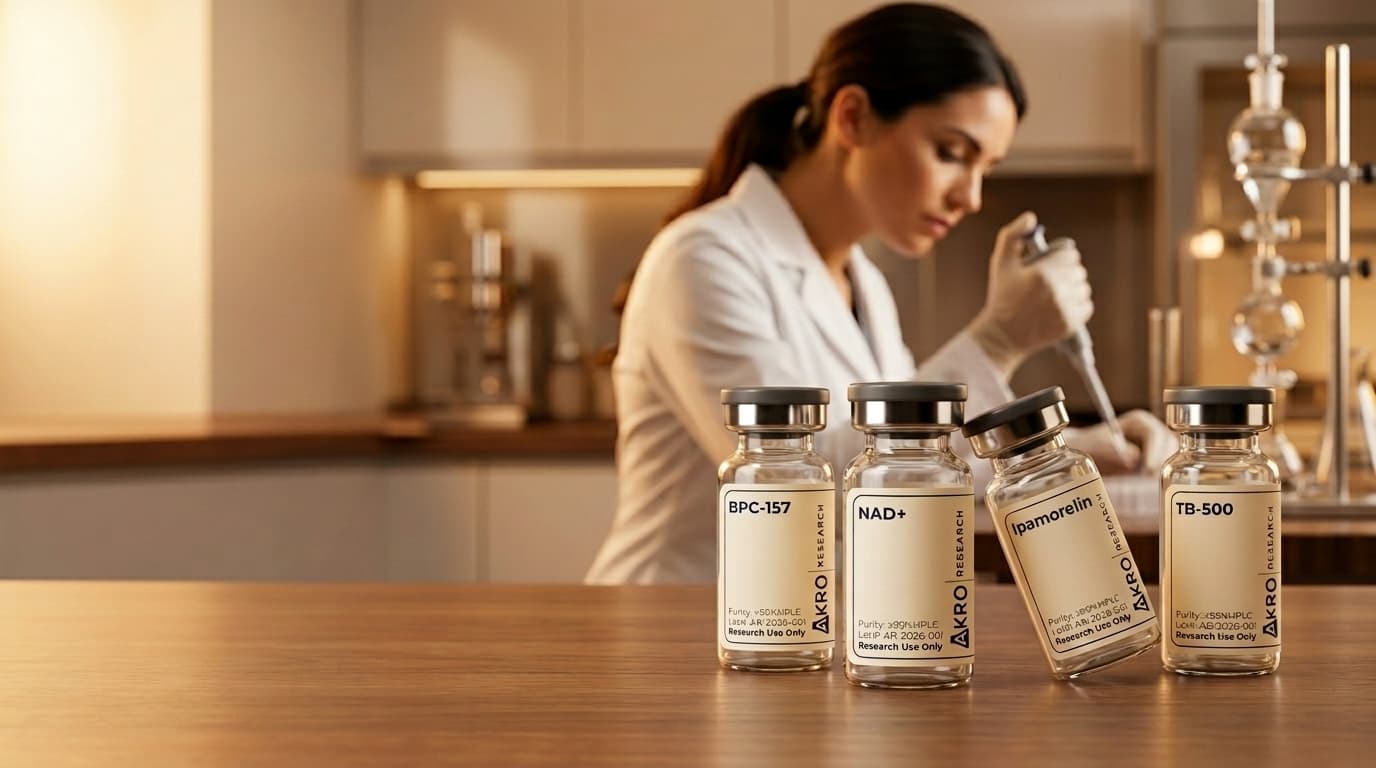
About AKRO Research
Science
Without
Shortcuts.
Every compound in our catalog is produced to rigorous research-grade standards, independently tested by accredited third-party laboratories, and shipped freeze-dried with a published Certificate of Analysis per lot.
Guaranteed Purity
Every lot we carry
Cleanroom Standard
<0.01% contamination risk
Manufacturing Standard
Validated protocols
Independent Testing
HPLC · LC-MS/MS
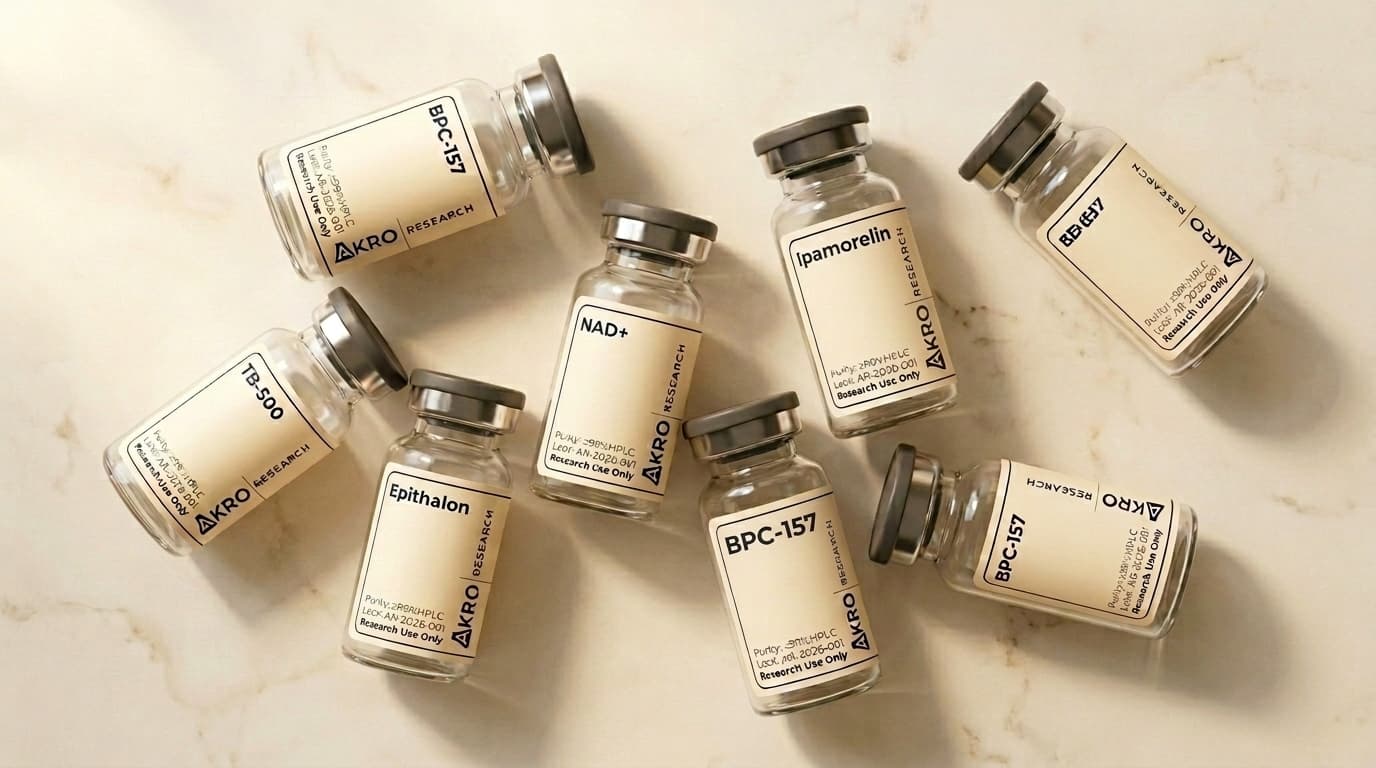
Verified Quality
Tested.
Verified.
Published.
Every compound in our catalog is produced in ISO Class 5 certified cleanrooms under cGMP protocols — the same rigorous environmental controls used in high-precision research compound synthesis.
Before any lot is listed, it is independently characterized by a third-party accredited laboratory. The full Certificate of Analysis is published on the product page — before you purchase, not after.
Manufacturing Standards
How the products
are made.
The facilities that produce our compounds hold three globally recognized quality certifications — applied to every batch, without exception.
ISO Class 5 Cleanroom
cGMP Manufacturing
Research-Grade Production Facility
Production takes place in ISO Class 5 laminar flow cleanrooms — a controlled environment standard that minimises contamination risk throughout the synthesis process. cGMP protocols govern every step, with full batch documentation.
- ISO Class 5 (max 3,520 particles/m³)
- 240–360 air changes per hour
- Validated production protocols
- Full batch record traceability
ISO 9001:2015
Quality Management System
Consistent Lot After Lot
ISO 9001:2015 certification means quality is systematically managed — not just checked at the end. Continuous process improvement, supplier qualification, and non-conformance controls ensure every batch meets the same standard.
- Continuous process improvement
- Documented quality controls
- Supplier qualification audits
- Non-conformance tracking
Independent
Third-Party Verification
Published. Transparent. Verifiable.
Every lot is sent to an independent, accredited analytical laboratory. Their Certificate of Analysis is published directly on the product page — visible before you order, not available on request.
- Accredited external laboratory
- HPLC purity ≥99% per lot
- LC-MS/MS identity confirmation
- COA published per lot
Shipping Integrity
From production facility
to your bench. Unchanged.
All compounds are shipped as lyophilized (freeze-dried) powder in sealed, sterile vials. This is what ensures the product that arrives is identical to the product that passed testing.
Stable at Room Temperature
Lyophilization removes water — the primary driver of peptide degradation. The sealed powder form is chemically stable during ambient-temperature transit, with no cold chain required.
Ships via Standard Courier
No cold chain, no hazmat classification, no carrier restrictions. Lyophilized compounds ship via standard courier to any destination — arriving in the same condition they left our facility, regardless of transit time.
Sealed Sterile Integrity
Vials are sealed under sterile conditions post-lyophilization. Protective packaging shields from light and moisture. Integrity is maintained from the production facility to your lab bench.
Storage Guidelines
Freezer
-4°F
(-20°C)
Long-Term
Maximum stability
2–5 years
Ambient
45–104°F
(7–40°C)
Distribution & Transit
Room temperature safe
Up to 6 months
Fridge
36–46°F
(2–8°C)
Reconstituted
Use per research protocol
6 weeks
From Production to Delivery
Every lot. Every step.
The path from production facility to your lab involves no shortcuts and no gaps.
ISO Class 5 Production
Laminar flow cleanroom, cGMP protocols
Quality Testing
HPLC + LC-MS/MS, identity confirmed
3rd-Party Verification
Independent accredited laboratory
COA Published
Lot-specific, public, verifiable
Sealed & Dispatched
Lyophilized, sterile-sealed, room-temp stable
Our Mission
Built for researchers.
Held to the
highest standard.
AKRO Research exists because the scientific community deserves research compounds that match the rigor they bring to their own work.
Every compound we carry is produced to rigorous research-grade standards, independently verified by accredited third-party laboratories, and backed by a published Certificate of Analysis — so researchers have the data they need before they ever place an order.
Research-grade production standards
Every compound is produced in ISO Class 5 certified cleanrooms under cGMP protocols — rigorous environmental controls that minimise contamination risk throughout the synthesis process.
Radical transparency
Every lot number has a published Certificate of Analysis from an independent, accredited laboratory. No request forms. No vague assurances. Verified data, available before you purchase.
Integrity from production to delivery
Lyophilization ensures the compound that arrives at your lab is identical to what passed testing. Stable during transit. Sealed until you open it. No cold chain required.
Quality Credentials
cGMP
Certified Production
ISO 9001
Quality Management
HPLC
Purity Verification
LC-MS/MS
Identity Confirmed
≥99%
Guaranteed Purity
Quality credentials you can verify — every lot, every time.
Degradation Science
What breaks peptides down —
and how we prevent it
Understanding the mechanisms of peptide degradation explains every choice we make in packaging, sealing, and shipping.
Heat Exposure
Elevated temperatures accelerate nearly every degradation pathway. Every 10°C rise roughly doubles the rate of chemical breakdown — which is why long-term freezer storage extends shelf life so dramatically compared to ambient conditions.
Moisture & Hydrolysis
Water is the #1 enemy of lyophilized peptides. Even trace humidity triggers hydrolysis — the cleavage of peptide bonds. Our sealed vials eliminate moisture exposure from packaging through delivery.
Light & UV Exposure
Photodegradation is a significant but overlooked risk. UV and visible light can cause bond cleavage and structural changes. Our light-blocking packaging prevents this throughout transit.
Oxidation
Oxygen reacts with certain amino acid side chains, altering their structure and biological activity. Lyophilization and sealed vials dramatically reduce available oxygen at the molecular level.
Freeze-Thaw Cycling
Repeatedly freezing and thawing reconstituted peptides causes physical and chemical stress — ice crystal formation can disrupt peptide structure and accelerate aggregation. Aliquoting before freezing eliminates this risk.